7 Small Changes in Daily Conversation That Families Should Notice
When you care about an aging parent, the little things in conversation can matter: repeated questions, unusual tiredness, fewer details, or a sudden change in mood. Here’s what to notice without panicking.

Sometimes the first sign that something has changed is not a missed appointment, a fall, or a medical report.
It is a sentence.
“I’m fine, son.”
“I already told you that.”
“I don’t remember what I ate.”
“Nothing much happened today.”
For families caring for an aging parent or loved one, daily conversation can carry small clues. Most of them are ordinary. Everyone forgets a word, has a low-energy day, or repeats a story sometimes. But when changes become frequent, unusual, or connected to daily life, they are worth noticing gently.
This article is not about diagnosing anyone from a phone call. It is about paying closer attention, with love, before worry turns into crisis.
1. They repeat the same question more often than usual
Repeating a question once in a while is normal. But if your parent asks the same thing several times in one conversation, or forgets something you discussed yesterday, it may be a sign to pay attention.
Examples:
- “When are you coming?” repeated multiple times in one call
- Asking again about an appointment they confirmed earlier
- Forgetting recent family news they were told clearly
The key is not one moment. The key is pattern.
A simple way to respond is: “No problem, I’ll remind you again. I know there’s a lot to keep track of.” Avoid making them feel embarrassed. Shame often makes people hide changes.
2. They struggle to find familiar words
Many people occasionally pause to find the right word. That can be normal aging, tiredness, or stress.
But it is worth noticing if your loved one frequently stops mid-sentence, uses unusual names for familiar objects, or loses the thread of what they were saying.
For example:
- Calling a TV remote “that button thing”
- Stopping halfway through a sentence and not knowing how to continue
- Having more trouble following a normal conversation
According to the Alzheimer’s Association, new problems with words in speaking or writing can be one of the warning signs of dementia, especially when it affects everyday conversation.
That does not mean you should panic. It means you should write down what you noticed and see whether it continues.
3. Their stories become much shorter
If your parent usually tells you details, jokes, complaints, neighborhood updates, or small stories from the day, and suddenly they only say “fine” or “nothing,” that change can matter.
Shorter answers may mean many things:
- They are tired
- They are feeling low
- They are lonely
- They do not want to worry you
- They are having trouble remembering details
- They are overwhelmed by daily tasks
Try asking gentle, specific questions instead of broad ones.
Instead of: “How was your day?”
Ask: “What did you eat for lunch?”
Or: “Did you go outside today?”
Or: “Who did you speak to today?”
Specific questions make it easier for someone to answer without feeling tested.
4. They sound unusually tired, flat, or withdrawn
A change in emotional tone can be just as important as a change in memory.
If your loved one usually sounds lively but now sounds flat, uninterested, or unusually quiet, it may point to loneliness, depression, poor sleep, pain, medication effects, or another health issue.
Watch for phrases like:
- “I don’t feel like talking.”
- “There’s no point.”
- “I’m just tired all the time.”
- “I don’t go out much anymore.”
- “Everyone is busy.”
This is where families should be careful. Do not jump into fixing mode immediately. Start with presence.
Try: “I’m glad you told me. Has it been like this for a few days, or longer?”
5. They seem confused about time, plans, or sequence
Everyone mixes up dates occasionally. But confusion becomes more concerning when it affects daily life.
Examples:
- Forgetting what day an appointment is on
- Thinking an event already happened when it has not
- Mixing up morning and evening routines
- Not remembering whether they took medication
- Being unsure why they went somewhere
The CDC notes that dementia is not a normal part of aging, and changes that affect daily decisions or functioning should be discussed with a doctor.
Again, one confused moment does not mean something serious. But repeated confusion deserves attention.
6. They avoid topics they used to discuss easily
Sometimes families notice what is missing.
Maybe your father used to talk about his garden but now avoids it. Maybe your mother used to mention friends from temple, church, or the neighborhood, but now never brings them up. Maybe they stop talking about bills, cooking, hobbies, or appointments.
Avoidance can happen because the topic has become difficult.
They may be embarrassed that they forgot something. They may have stopped doing an activity. They may not want you to know they are struggling.
A gentle question helps:
“I noticed you haven’t mentioned your walking group lately. Are you still going?”
Keep the tone curious, not investigative.
7. Their mood changes quickly during normal conversation
Mood changes can happen for many reasons: pain, poor sleep, grief, anxiety, medication, loneliness, or cognitive changes.
Notice if they become:
- More suspicious than usual
- Easily upset by small changes
- Suddenly fearful
- Irritated by normal questions
- Tearful or anxious during simple conversations
Mayo Clinic lists personality changes, depression, anxiety, agitation, and suspiciousness among possible dementia-related symptoms, though these can also come from many other treatable causes.
The most useful thing families can do is track the change, not argue with it.
Instead of: “Why are you acting like this?”
Try: “You sound upset. Did something happen today?”
What to do if you notice a pattern
Do not turn every conversation into an exam. Your loved one should not feel watched, judged, or tested.
Instead, do three simple things.
First, write down what changed. Include the date, what you noticed, and whether it happened again.
Second, ask practical questions gently. Food, sleep, medication, pain, appointments, and social contact often explain more than we think.
Third, talk to a doctor if the change is sudden, repeated, or affecting daily life. Sudden confusion, slurred speech, severe weakness, chest pain, breathing trouble, or signs of stroke should be treated as urgent.
For non-urgent changes, a primary care doctor can help check for causes such as medication side effects, infection, dehydration, depression, sleep problems, hearing issues, or memory-related conditions.
A simple way families can stay aware without calling from worry
Many caregivers live with a strange kind of guilt.
You want to check in every day. But you also have work, children, time zones, bills, and your own life. And sometimes your parent does not want another serious call that feels like monitoring.
This is where daily voice check-ins can help.
famly.care is built around a simple idea: a warm voice agent talks with your loved one regularly, asks gentle questions, and helps the family notice patterns over time. It is not a doctor, and it does not diagnose. But it can help caregivers stay aware of wellbeing, mood, routines, appointments, and small changes in conversation.
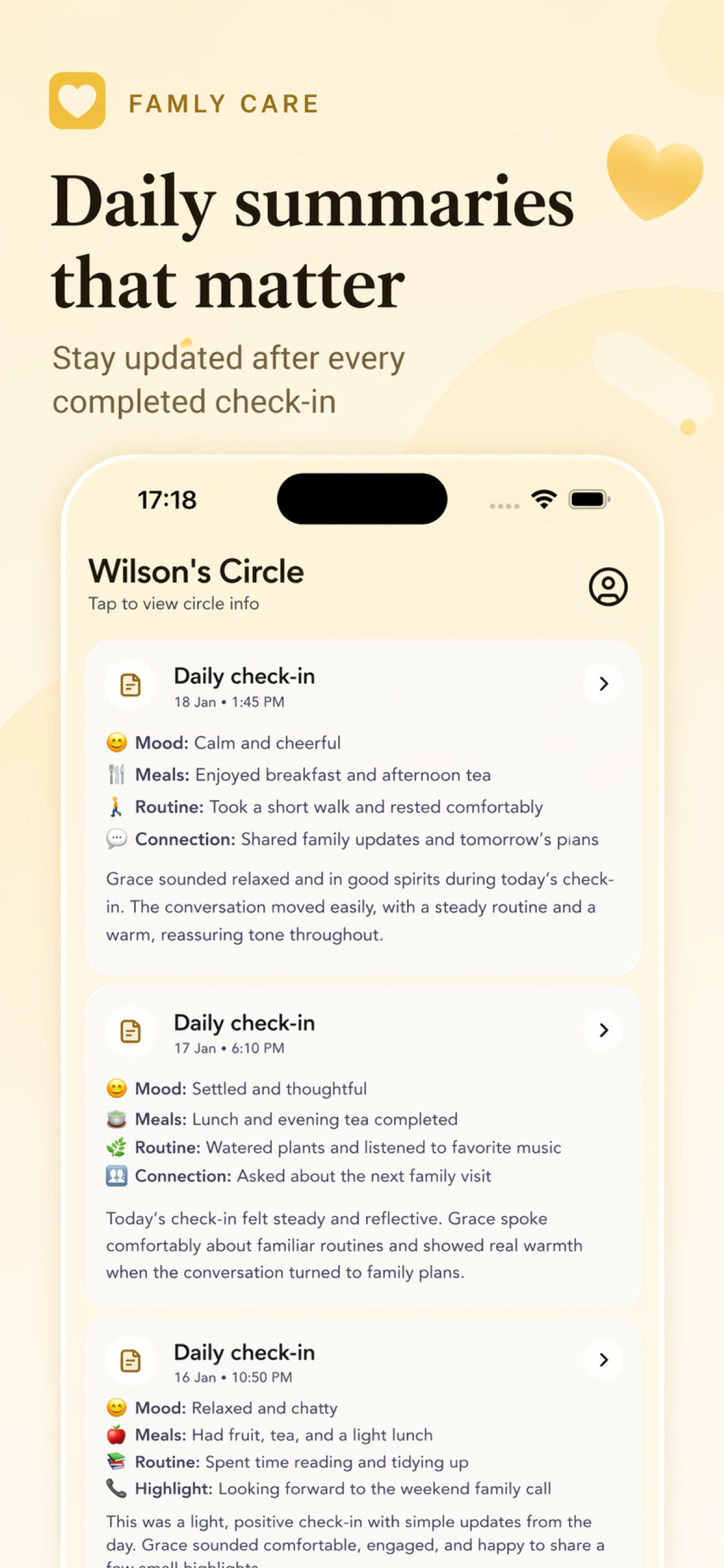
A short daily conversation can become a useful update for the family.
Not because technology replaces care.
Because sometimes care needs a little help staying consistent.
Final thought
The goal is not to become afraid of every pause, repeated story, or quiet day.
The goal is to notice with kindness.
Small changes in conversation may be nothing. They may also be the first sign that your loved one needs more support, more connection, or a medical check-in.
When families listen closely, they do not just hear words.
They hear patterns. They hear loneliness. They hear changes. They hear when “I’m fine” might mean “please keep checking on me.”
Sources
- Alzheimer’s Association: 10 Early Signs and Symptoms of Alzheimer’s and Dementia
https://www.alz.org/alzheimers-dementia/10_signs - CDC: Signs and Symptoms of Dementia
https://www.cdc.gov/alzheimers-dementia/signs-symptoms/index.html - Mayo Clinic: Dementia Symptoms and Causes
https://www.mayoclinic.org/diseases-conditions/dementia/symptoms-causes/syc-20352013